
All Betrayed
Rescue The Republic, Right-Wing Peaceniks, and America First bought the anti-war promise. Trump just sold it. Let's see how it plays out in 10 days... and in 8 months.


As it suits in our world missing nuances, let’s start with two disclaimers:
A theocracy is as less desirable a regime as an ethnocracy. But it’s up to the people of each country to decide their fate, may they be Iranian, Israeli, or from any other country in the Middle East. You can’t impose democracy from outside, and if the people are not willing to make their voices heard, or if they can only act upon commands from foreign nations meddling in their internal affairs, then the respective country is not yet mature enough (or anymore), for democracy. As the Trump-Vance campaign clearly helped Americans realize, not only does imposing regime change never achieve the official intended goal, but sacrificing your soldiers’ life to a policy that fails at regime change and just floods with wealth the military-industrial complex is certainly the most nauseous part of decades of American foreign policies.
These decades of failure and slaughtering both foreign civilians and America’s blue-collar sons are now continued by Trump.The now very likely return of the Democrats in power in the United States is not good news. We must remember where we were back during the years 2020-2024: the rise of a censorship-industrial complex meant to undermine one of America’s greatest features—the First Amendment—, a total lack of effort to bring an end to the wars in Ukraine and Gaza, and a profound incapacity to question the COVID-era policies and go after the bad actors and beneficiaries of those policies. From a free-speech standpoint, we are still in the cycle where the Republicans are the ones pushing against censorship and mandating the release of critical documents regarding the weaponization of social media moderation and the EU’s Digital Services Act against legitimate voices and legal speech. One could hope that America’s conservative revolution would deliver years of progress on the free-speech front, and give an opportunity for the Democrats to reinvent themselves—an opportunity for the Left to remember free speech once was a value it fought for.
Such hope is now evaporating, with Trump leading the Republicans toward a mid-term failure that will likely bring back an unchanged Democratic party in power. As Matt Taibbi stated back in 2021, “to stop war, America needs a new party.” Unfortunately we’re not quite there.
This introduction being made, let’s go back to the betrayed of the coalition that got Trump elected.
Rescue the Republic
On September 29, 2024, a large and deliberately cross-ideological rally assembled near the Washington Monument under the banner “Rescue the Republic.” Organized by Bret Weinstein and featuring voices as varied as RFK Jr., Matt Taibbi, Tulsi Gabbard, Jordan Peterson, Russell Brand, Col. Douglas MacGregor, JP Sears, and Rob Schneider, it was an attempt — awkward in the eyes of mainstream media, yet historically significant — to articulate a set of concerns that did not fit neatly into either party’s platform: the weaponization of medicine and science, surveillance expansion, censorship-by-proxy, institutional capture. Many of its participants had supported Trump’s return to power not out of ideological affinity but out of a strategic wager: that disrupting the existing machinery was a precondition for any genuine reform.
The Rescue the Republic coalition was perhaps the most intellectually serious of the heterodox tendencies that powered Trump’s 2024 victory. It was post-partisan in a genuine sense — not the triangulating, split-the-difference centrism of the consultant class, but a convergence of people who had been burned by both parties and had arrived at similar conclusions from different starting points. RFK Jr. brought what was to become the MAHA constituency. Taibbi brought the documentation of censorship infrastructure. Gabbard brought the military veteran’s disillusionment with regime-change wars. Weinstein brought the academic and scientific practice of challenging captured institutions. Altogether, they had made the case that American institutions had been captured by interests that profited from permanent crisis, whether medical, informational, or military. They didn’t close some of the dots, especially those related to the power of neo-conservatism and its relation to the AIPAC lobby. Maybe they should have, at least those in the movement who could have done it. And of course, it was never a true marriage—people who knew what Trump was probably didn't expect much beyond “not being the Dems'“…
But some of those who became part of the new administration while carrying the hope of a different policy — like Tulsi Gabbard — have either been betrayed, or have betrayed their own values by standing with this new warmongering American administration.
Right-Wing Peaceniks
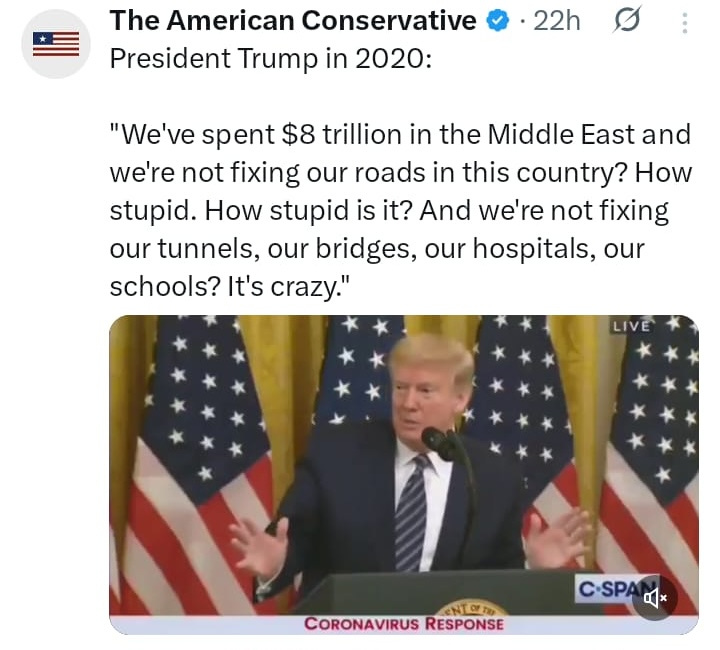
The right-wing peacenik trend was documented by The Free Press back in 2023, when it still seemed like a political curiosity rather than a serious force — it has now arrived at its moment of maximum moral dilemma and should probably diagnose its own political impotence, or break with Trump. From Tucker Carlson’s network to the pages of The American Conservative, this was the corner of the right that had spent years doing the slow, difficult work of challenging Christian Zionism from within Christian conservatism itself. George O’Neill Jr.’s question, published in a great article in The American Conservative — “What would Jesus do?” — was never merely rhetorical; it was a genuine attempt to pry evangelical voters loose from the theological scaffolding that had made them reliable supporters of every Israeli military operation, no matter how disproportionate. That argument, painstaking in its biblical referencing and scrupulous in its moral logic, now faces the bluntest possible dilemma: their champion has started yet another American Middle East war, and, once again, one sold by Benjamin Netanyahu.
The right-wing peaceniks had arrived at their position the hard way — through Iraq. Rod Dreher, senior editor at The American Conservative, had cheered the invasion in 2003 and spent two years watching it unravel before concluding that "the United States cannot solve all the evils of the world and, in trying to, we can unleash worse ones." That disillusionment had hardened, over two decades, into a comprehensive distrust of the entire security apparatus — not just the wars, but the institutions waging them: the FBI, the CIA, the Pentagon. These were not separate grievances but a single diagnosis: a state that had lied its way into Iraq, surveilled its own citizens, and "gone woke" to placate elites was not a state whose judgment on Iran deserved deference.
The right-wing peaceniks also make the case that decades of American Christian Zionist support has backed policies enabling starvation, that Netanyahu’s own government had for years facilitated Hamas’s funding as a strategic tool, that the October 7 attacks did not emerge from a vacuum but from a cynical policy meant to prevent any Palestinian statehood. They had noted — with a discomfort that the mainstream right found unseemly — that America’s Middle East wars had shattered ancient Christian communities across Iraq, Syria and Lebanon, the very communities whose spiritual ancestors had known Jesus’ disciples.
What is most striking about this tendency is its potential for theological and moral seriousness—not opposing intervention from isolationism or indifference, but from a reading of the Gospels that mainstream American Christianity has systematically suppressed. “Blessed are the peacemakers” is not, in this reading, a nice sentiment to stitch on a cushion; it is a political program. When Jesus rebuked Peter for raising a sword in the Garden of Gethsemane — “all who live by the sword will die by the sword” — he did not just offer pastoral comfort; the call for non-violence, the rebuke of the talionic rule, could just as well articulate a foreign policy. One that can, in our era, carry civilizational greatness for the West—altogether with the respect of the rule of law and the promotion of a pacified rule-based international order. Civilizational greatness instead of letting the US remain a chaos-waging empire that the rest of the world observes with contempt. An Empire that now identifies with some of the most brutal and backward of identity politics: triggering a war hand in hand with an ethnocracy that the whole world has just witnessed committing a genocide.
If left-wing peaceniks root their universalism in a certain interpretation of Enlightenment humanism, the right-wing peaceniks root it in the universalism of Christianity. There is a sense that, for a moment, both could have traded absolute principles for the practical outcome that “Trump-the-deal-maker” could have delivered, as long as it meant peace and less killing — net positive realism rather than grandstanding with no impact, real progress toward peace instead of powerless posing and virtue signalling. Anyway, peaceniks now form another backstabbed class as the obvious outcome of Trump’s war is that it will either plunge Iran and the region into chaos, as it did after every single American Middle East war, or plunge the whole world into chaos. So far, we are likely heading toward the second scenario, as the killing of Ayatollah Khamenei has already triggered a call for Jihad around the Shia world — literally making this regime change operation an uncontrollable religious war.
America First—Betrayed Too
“We’ve defended the borders of other nations while leaving our own borders wide open for anyone to cross and for drugs to pour in at a now unprecedented rate. And we’ve spent trillions and trillions of dollars overseas, while our infrastructure at home has so badly crumbled. […] America has spent approximately $6 trillion in the Middle East — all the while our infrastructure at home is crumbling. With this $6 trillion, we could have rebuilt our country twice, and maybe even three times if we had people who had the ability to negotiate.” — President Trump, Joint Address to Congress, February 28, 2017
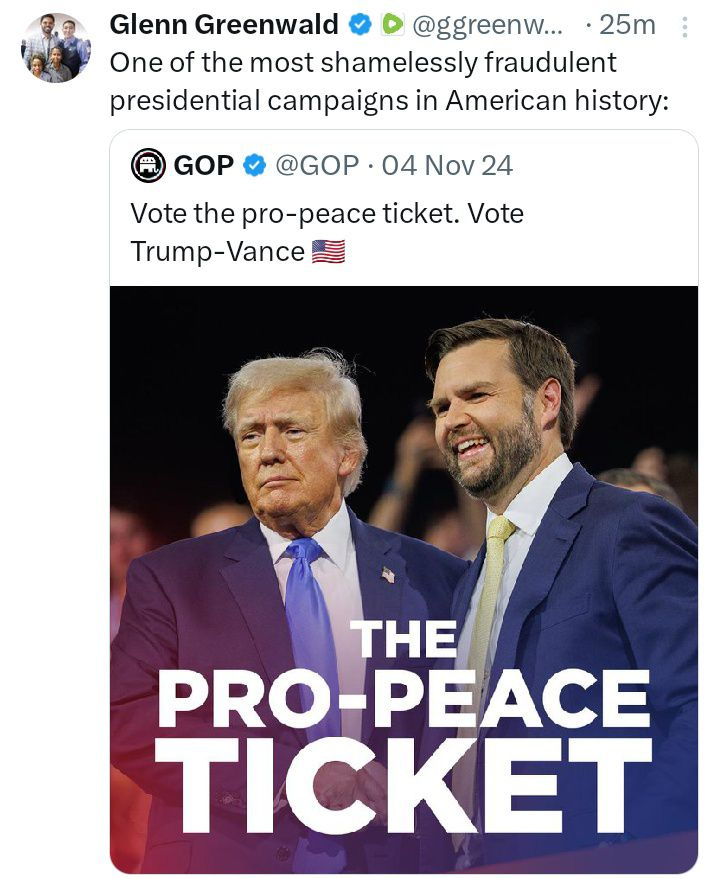
"America First" in its Trump incarnation was built on one foundational promise above all others: no more endless wars. Reducing U.S. military commitments abroad, demanding that allies pay their share, getting out of the nation-building business — these were not peripheral talking points but the emotional core of Trump's appeal to the post-industrial heartland voters who had watched their sons return from Iraq and Afghanistan in flag-draped coffins while the contractors got rich and the political elite, Democrats as well as Republicans, had made fortunes from stock trading, including by investing in the war machine they were financing with their votes. Picking veteran and working-class JD Vance as Vice President signalled it even more, offering, in case Trump would not finish his term, a wise replacement in rupture with the neoconservative establishment.
Yet none of that messaging proved any match for the persistent lobbying of neoconservative holdouts and Senate hawks. At the forefront of the hawkish chorus stood Lindsey Graham—Trump’s golf partner, his confidant, his most relentless Senate cheerleader for military action against Tehran. A longtime advocate for regime change in Iran, Graham hailed the strikes as overdue, suggesting they could become “a Berlin Wall moment for Iranian freedom.” He had praised massive U.S. aid to Ukraine as among “the best money we’ve ever spent” since others were doing the dying. And when the International Criminal Court threatened to target Israeli leaders, Graham warned that “we’re next,” promising to sanction even U.S. allies to shield preferred partners from accountability. Indeed, if the ICC is allowed to prosecute Netanyahu for war crimes, the next war criminal risking answering for their actions are in Washington D.C. Graham, the man who had Trump’s ear never stopped pushing for this war. Behind Graham stood the financial architecture of Miriam Adelson, who with her late husband Sheldon poured hundreds of millions into Trump campaigns and related efforts, often with explicit conditions tied to maximalist pro-Israel policies. AIPAC-aligned networks completed the ecosystem, framing any restraint as weakness in the face of Iran’s nuclear ambitions. And behind all of them, the broader neoconservative infrastructure who never truly left the building, just waited for the donor dollars and lobby pressure to realign the “disrupter” president with their forever-war playbook. The result: the most dramatic American military intervention in the region in decades, launched at Israel’s side with regime-change rhetoric straight from the 2000s neocon playbook.
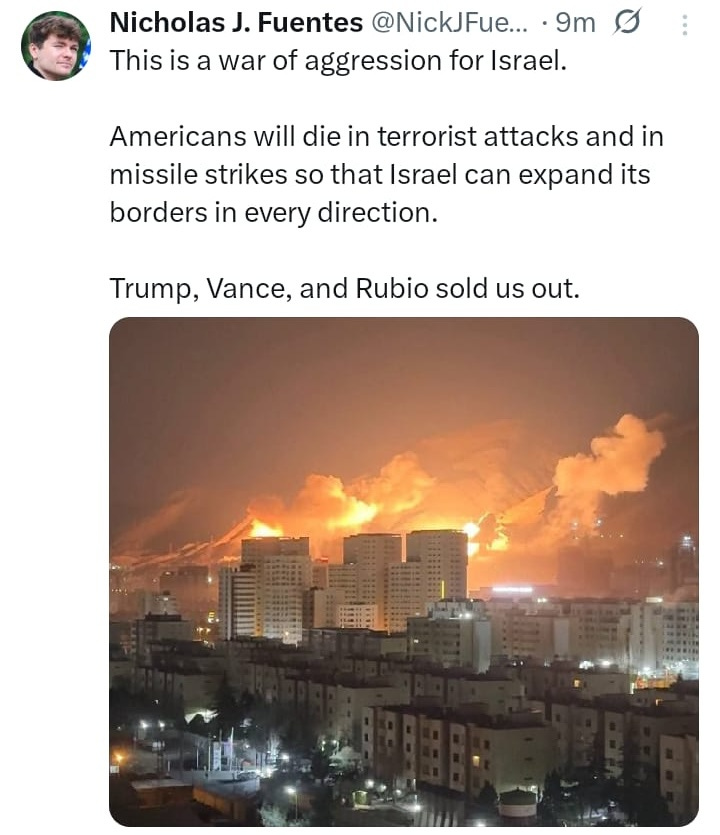
Then there is the Fuentes wing of America First — the AFPAC crowd, the "Groypers," that America First fringe that has never hidden its hostility to what it calls "Zionist influence" over American foreign policy — often pointing to donors like the Adelsons and groups like AIPAC as the very mechanisms of that influence. Fuentes' recent appearance on Tucker Carlson's podcast has triggered an internal civil war within the American right, reaching all the way to the Heritage Foundation and Charlie Kirk's Turning Point USA. The Groypers' online behavior largely relies on humor and trolling. Fuentes' worldview is consistent with America First, nationalism and traditionalism, but large parts of his rhetoric qualify as antisemitism on several counts — most explicitly in its deployment of the "dual loyalty" trope, the belief that American Jews cannot distance themselves from a foreign country thousands of miles away and are therefore unable to put America first. In the same podcast, he also identifies Jews as the original neoconservatives — former Democrats who migrated to the Republicans (hence the "neo"), bringing their hawkish interventionism with them.
With the Iran war, the betrayal is complete across both wings of America First. The next question — the one that matters more than any hot take about the first ten days of the war — is what happens in eight months. Midterm arithmetic is already brutal for a party in full control of government during an unpopular war. If the war goes badly — and wars with Iran have a long history of going badly in ways that were entirely predictable — the electoral consequences will be severe. The deeper tragedy is that the political force most capable of institutionalizing an anti-interventionist conservatism may end up so discredited by association with this adventure that it cedes ground back to a Democratic Party that never disavowed neoconservatism and is flooded by AIPAC money anyway. Alternatively, the Fuentes crowd could gain more and more power in a strategy to remove AIPAC-backed candidates from the Republican party — using a rhetoric that may well, in the already disastrous xenophobic atmosphere in the US, target a new scapegoat: Jews in general, no matter if they actually support the Middle East ethnocracy that just committed a genocide and may have started World War 3, hand in hand with the Trump administration.
As this piece is being written, the first plumes of smoke are rising from the Strait of Hormuz. The Palau-flagged tanker Skylight, struck by Iranian fire for “defying orders” to transit amid the chaos, is reportedly sinking — crew of twenty evacuated, the strait that carries a fifth of the world’s seaborne oil now a theatre of active naval warfare. This is the bill arriving in miniature. The larger bill looms just beyond the horizon: two American carrier strike groups positioned brazenly within Iran’s missile envelope — the USS Abraham Lincoln already pounding targets from the Arabian Sea, the USS Gerald R. Ford surging in as the world’s most powerful floating airfield, both within range of Tehran’s Fattah-2 hypersonic missiles, reportedly deployed in combat for the first time, maneuvering at Mach 15 to evade layered defenses.
No U.S. capital ship has been lost to enemy fire since Israeli jets and torpedo boats nearly destroyed the USS Liberty in 1967. Should Iran land even a glancing blow on one of these big sitting ducks — damaging it, or in the nightmare scenario, sinking it — the symbolic arc would close with brutal finality: American sailors dead, American hardware burning, in a war launched at a foreign government’s request, prosecuted with American blood and serving first and foremost Israeli strategic objectives.
The heartland voters who believed the “no more endless wars” promise would not need a pundit to explain the betrayal to them. They would feel it in their bones — and they would arrive, more than ever, at the conclusion that their sons and daughters have absolutely no business dying in the Middle East. Not for regional ambitions that shift with every election cycle in Tel Aviv. Not for Greater Israel. Not for a foreign leader whose government has spent decades manipulating American policy through donor pipelines and lobby networks. Not for any quantity of AIPAC money laundered through primaries. Americans have no reason to accept that kind of sacrifice of American lives. That realization — when it comes, and it is coming — will express itself at the ballot box, eight months from now, with the blunt arithmetic of a country that has finally had enough.
As for Israeli society, Gideon Levy recently acknowledged the painful reality of his fellow citizens' consent to genocide. Whereas supremacists try to frame Netanyahu as one of the greatest Jewish leaders of all time, it is highly possible that the cost Israel will pay from Iran's retaliation to the Israeli-American aggression will rather send Israel's Prime Minister to the top of the hall of shame of Jewish history. Such a conclusion may come from military setback, or from Israelis finally ousting their leader: a man currently investigated for war crimes by the International Criminal Court.